Architecture
For contributors: how the codebase is organised and where to make a change.
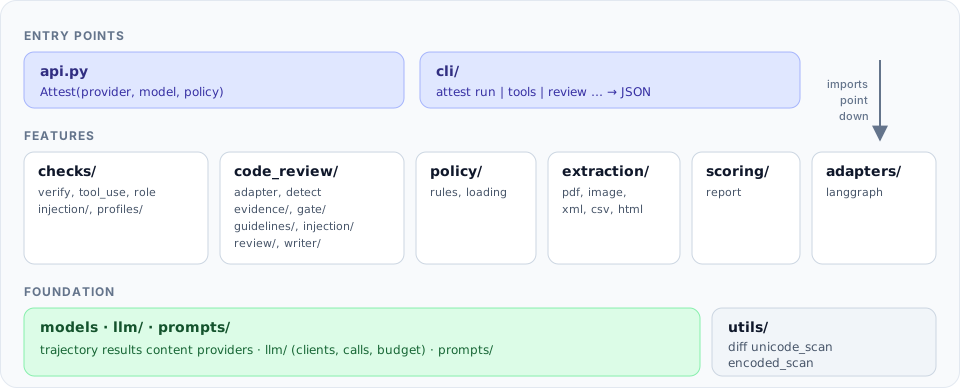
attest is split into layers. Imports only point down: entry points use the features, and
features use the shared foundation (the data models, llm/, prompts/) and
utils/. The foundation never imports a feature, so a feature can't quietly become a
dependency of everything else.
Layers
Entry points. api.py holds Attest, which keeps the provider, model, client and policy
and runs checks with them. cli/ is the attest command, one module per command group in
cli/commands/. Both are thin and call into the features. Every command prints its result
through cli/json_output.py, which holds the versioned JSON envelope, the per-command output
models and the JSON Schemas built from them. cli/usage_errors.py prints usage errors, such
as an unknown option, as the same JSON error envelope.
Features. One package per job:
| Package | Job |
|---|---|
checks/ |
Faithfulness (verify.py), tool use, role adherence and prompt injection. profiles/ picks the grading standard for each answer kind. |
code_review/ |
Code review mode: the adapter from reviewer outputs to runs, evidence budgeting, the gate, injection checks for diffs, review guidelines (guidelines/), the one-call review() (review/), and attest's own reviewer (writer/). |
policy/ |
Project rules: models, loading from YAML or JSON, deterministic and semantic evaluation. |
extraction/ |
Bounded text extraction from PDFs, images, XML, CSV, HTML and JSON for the injection scan. |
scoring/ |
evaluate(), which runs the selected checks and assembles a Report. |
adapters/ |
Converters from agent frameworks to runs. LangGraph and Haystack are built in. |
Foundation.
| Package | Job |
|---|---|
| Data models | trajectory.py, results.py and content.py: Trajectory, Report, CheckResult, Finding, Artifact. |
disposition_rules.py |
How a finding's check, verdict and severity map to pass, review or block. VerdictPolicy passes its choices; a Report uses the defaults for findings without a disposition. |
providers.py |
The supported providers, their model lists and API keys, and building a client. |
llm/ |
The structured call() and vote(), the provider clients, response caching, and spend budgets. |
prompts/ |
Every prompt attest sends, one module per feature, with PROMPT_VERSION in prompts/version.py. |
utils/ |
Small stateless helpers shared across features: unified-diff parsing, hidden-Unicode and encoded-payload scanning, strict JSON and YAML loading. |
Design rules
- Tool outputs are the only evidence. No check reads the agent's
thoughttext when deciding whether a claim is true. - Untrusted text is data. Anything an attacker could write reaches a judge only inside a bounded, escaped, clearly delimited block, framed as content to judge.
- Prompts live in one place. All prompt text is in
prompts/. Each answer kind has its own module inprompts/profiles/, and tests pin thefactualandplanprompts by SHA-256, so work oncodecan't change how plain text is graded. - Incomplete is not clean. Content that couldn't be scanned or extracted, or a budget that ran out, is reported as incomplete coverage, never as a pass.
- Clients are lazy. Deterministic checks never create an API client, so they run with no key.
Where things live
| To change | Look in |
|---|---|
| How claims are extracted or verified | checks/verify.py, checks/profiles/, prompts/profiles/ |
| Any prompt text | prompts/ |
| The code review gate | code_review/gate/ |
| How review guidelines are parsed and checked | code_review/guidelines/ |
| How large diffs are cut | code_review/evidence/ |
| Injection patterns and detectors | checks/injection/ |
| Supported models | providers.py |
| Model calls, caching and budgets | llm/ |
| CLI commands | cli/commands/ |
| The CLI's JSON output and schemas | cli/json_output.py (then run docs/scripts/write_schemas.py) |