How it works
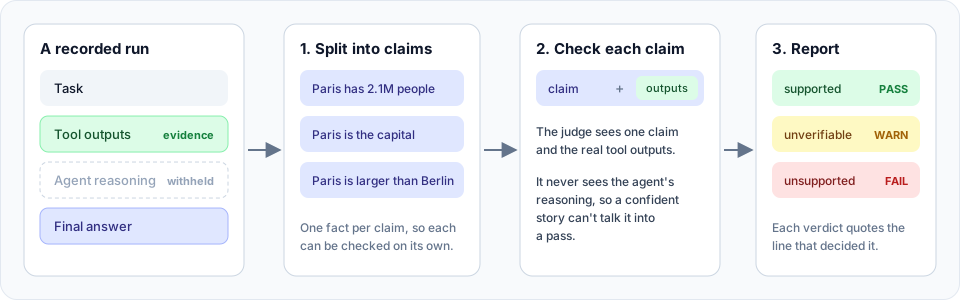
attest takes a run, a record of what an agent did, and treats its tool outputs as the only
evidence. Each check compares part of the run against that evidence and returns a
result made of findings. evaluate() collects the results into a report.
Runs
A run records one task from start to finish. In Python it is a Trajectory; on the command
line it is one JSON object (a .jsonl file holds one per line).
| Field | Meaning |
|---|---|
task |
What the user asked. |
system_prompt |
The agent's instructions. The role check uses it as the job description. |
allowed_tools |
Tools the agent may call. Calls outside this list fail the tool-use check. |
tool_fallbacks |
Optional. For each tool, the tools that can stand in for it when it errors, such as {"charge_card": ["charge_card_backup"]}. |
steps |
Each step has an optional thought and an optional tool_call with name, arguments, output and an optional is_error that overrides attest's guess. |
artifacts |
Files or images the agent received, such as a PDF or a screenshot. |
final_answer |
What the agent told the user. |
Evidence and the grading model
Tool outputs and artifacts are the only evidence attest trusts. Checks that need judgment, such as faithfulness, ask a language model (the grading model) one narrow question: does this evidence support this claim?
That is the difference from a plain "LLM judge", which reads the whole run and decides whether
the answer looks good. The grading model sees each tool output and each artifact in its own
escaped block and never sees the agent's thought text, so confident reasoning can't talk it
into a pass.
An artifact's block comes right after the output of the tool that returned it; artifacts on the
run itself come last. Artifacts with source: "user_upload" are not evidence. Artifact text
is always used. Binary (data_base64) and path artifacts are read only when you opt in with
Attest(extract_artifacts=True), through the same size-limited extraction the injection scan
uses; path artifacts also need allow_paths=True. A file that was cut short or couldn't be
read is marked complete="false", and the grading model is told not to count its missing parts
as support. Files left out are listed in the result's metadata["artifacts_unread"].
Results and findings
Every check returns a result with the same fields:
| Field | Meaning |
|---|---|
check |
The check's name: faithfulness, tool_use, injection, role or policy. |
passed |
Whether the check passed. |
score |
Between 0 and 1, or null for checks that don't score (role, injection). |
summary |
One line for people. |
findings |
One per claim, tool call or payload. |
Each finding has a severity of pass, warn or fail, and a verdict that depends on the
check, such as unsupported or suspicious. It names what it is about (subject), explains
itself (reason), and quotes the deciding tool output (evidence). step is the step index
when the finding is about one step.
Claims and verdicts
The faithfulness check splits the final answer into atomic claims and checks each one:
| Verdict | Means | Severity |
|---|---|---|
supported |
The evidence backs the claim. | pass |
unsupported |
The evidence contradicts the claim. | fail |
unverifiable |
The evidence doesn't say either way. | warn |
Answer kinds
What counts as "supported" depends on what the answer is. Pass answer_kind= to evaluate(),
or --kind to attest run:
| Kind | Use for | Standard |
|---|---|---|
factual (default) |
Reports of facts the tools returned. | The evidence must back the claim. |
plan |
Plans and recommendations. | The claim must match the plan in the evidence. Nothing has to have run yet. |
code |
Outputs of an AI code reviewer. | The diff and source must support the claim, read with the language's semantics. See Code review mode. |
auto |
Mixed workloads. | Picks factual or code from the evidence. |
Reports
evaluate() runs faithfulness and tool use by default; pass checks= for others. It returns a
Report with one result per check, plus a policy result when the Attest has a
policy. passed is true when the report's verdict (below) is
pass; checks_passed is true when every check passed, even if something still needs review. Its
overall_score is the mean of the scores that aren't null, and scores gives each check's
score by name.
Checks say what happened. A VerdictPolicy decides what happens because of it: each finding
gets a disposition of pass, review or block, and the report's verdict is the strictest
one. A blocking finding can't be averaged away by good scores elsewhere. blocking lists the
findings that blocked, with their check, verdict and subject. attest only reports; your code
decides what to do with the verdict.
By default these block: an unsupported claim, a disallowed tool, a tool error the answer
reported as success, a compromised injection, an out-of-scope request the agent complied with,
and a failed fail-severity policy rule. These go to review: a tool error the agent ignored, an
unnecessary tool call, a warn-severity policy rule, and a faithfulness result where no claim
could be checked against the evidence. Injection warnings pass, and so do unverifiable claims
when at least one other claim was checked. Any other failed finding blocks. A finding nothing
checked (unchecked, or metadata["checked"] false) goes to review, or follows its rule when
that is stricter, so a stricter policy never makes it weaker. The exception is a claim whose
check failed: on_inconclusive_faithfulness decides it. A Report you build yourself, without
evaluate(), gets the verdict the default policy would give it.
from attest import Attest, ToolUsePolicy, VerdictPolicy

judge = Attest(
    verdict_policy=VerdictPolicy(
        tool_use=ToolUsePolicy(on_unhandled_error="block"),
        on_injection_warning="review",
        min_score={"faithfulness": 0.9},  # below 0.9, passing claims go to review
    )
)
report = judge.evaluate(run)
if report.verdict == "block":
    raise SystemExit(f"blocked by {report.blocking}")
ToolUsePolicy also takes on_disallowed_tool, on_claimed_success and on_unnecessary_call.
VerdictPolicy also takes on_inconclusive_faithfulness (default review) and
min_claim_coverage, the lowest share of claims faithfulness must check before a run can pass
(off by default).
Pass rates and confidence
A pass rate from 20 runs is noisy. attest stats turns a pass count into a rate with a Wilson
95% confidence interval:
attest stats 41 50 | jq '.data'
# {"rate": 0.82, "low": 0.69, "high": 0.90, "n": 50}   (values rounded here)
from attest import difference_is_real

difference_is_real(41, 50, 35, 50)   # False: the gap is within noise
What attest doesn't do
attest is read-only. It never runs your tools, calls your agent, or needs credentials for anything except the grading model. It can only check what the run recorded, so a tool output that is missing from the run can't be used as evidence. Limitations lists what attest assumes and where its checks rely on heuristics.